
When the time comes that a further MOT test, repair, or attempt to sell your car does not make sense, the documents might be the next headache to think about. If you are planning to scrap my car Manchester, then the primary document that will need to be prepared is the V5C log book. But apart from this, there are some additional documents that need to be prepared before the collection. In case you forget any document at the last minute, the process will be stalled while you will try to find the missing document.
But you should relax, because there are no long and tedious paper work processes that have to be followed in order to scrap a car. The only important things to note are the identification of the car and the correct process of dealing with the DVLA.
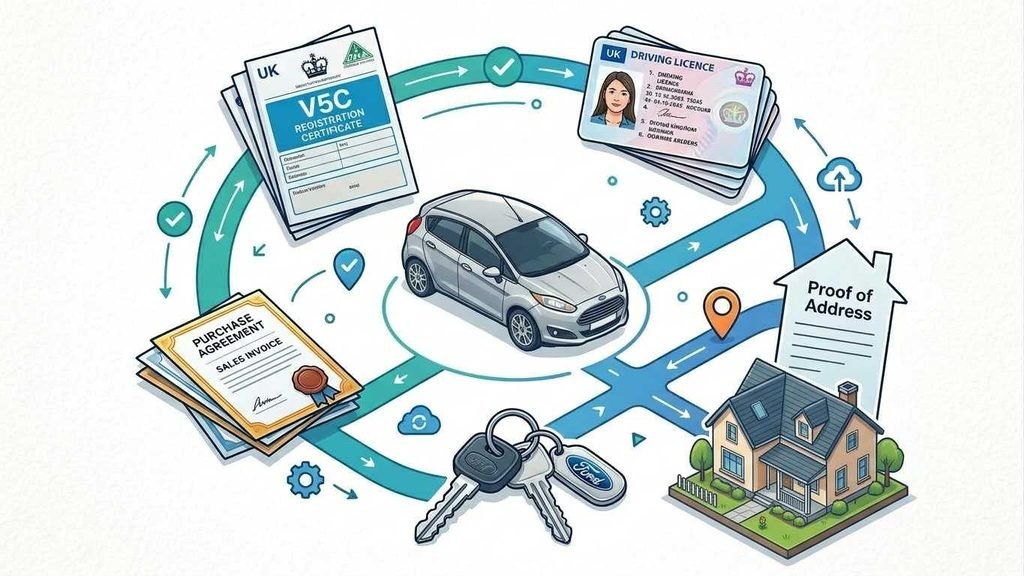
What You’ll Need to Scrap a Car in the UK
The first step is to distinguish between papers necessary for the operation of the vehicle from those which might only facilitate the collection process.
In most cases, the paper that needs to be found first would be the V5C Vehicle Registration Certificate, which is known as the logbook. It is better to keep this document handy as opposed to putting it away until the collection truck pulls up outside your house.
You might be required to show identification or proof of address depending on the procedure followed by the respective company or collection facility. Your driving licence or passport as well as a recent utility bill, bank statement or council tax document (when needed) might be useful to save you from any inconvenience.
Car keys are also important. While they do not belong to the DVLA papers, they constitute a proper handover. Should your car be locked, parked very close to another car or fitted with an electronic steering lock, this knowledge will prove useful before starting the collection.
It is useful to have a checklist of:
- V5C log book if you have it
- Photo ID if it is required by the collector
- Proof of address if it is required
- Vehicle keys including spare ones if you have any
- Finance documentation or any documentation related to settlement if the vehicle has a finance agreement on it
- Any additional documentation that might be asked from you at the time of booking the collection
It is important to remember that it is not necessary to take all this documentation for scrap car collection. A decent collector will make sure that they tell you everything they need.
If your scrap vehicle is going to be collected from an Authorised Treatment Facility (ATF), then GOV.UK mentions that the V5C should be given to the ATF and yellow section of the log book regarding the sale/transfer/part exchange of the vehicle to the motor trade should be retained.
The Core Documents Explained
The V5C is the key document
The V5C should be the first documentation that you would need to look for when deciding to scrap your vehicle.
The document carries valuable information on both the vehicle and its registered keeper. The information helps link the physical vehicle with the DVLA records. This becomes very handy especially in cases where the Manchester car has been parked in a driveway for years without any inspection being done from the time the previous owner relocated.
It should be noted that the V5C is not a title deed or ownership certificate. It is the vehicle registration document. This becomes critical because the disposal coordinator needs to have legal authority to dispose of the vehicle.
In the disposal of the end-of-life vehicle using an ATF, the V5C is one of the documents required in managing the vehicle records. The GOV.UK website advises that one gives the V5C to the ATF while keeping the yellow document.
It is important to understand that even though your log book might have gone missing, it does not necessarily mean that your car is not eligible for scrapping. It is wise to check out the DVLA advice first and see what can be done with the help of the collection company. In some cases, you can apply for a replacement V5C at the DVLA.
Photo ID and proof of address are identity checks
Photo ID and proof of address do not replace the V5C, although they may serve a helpful purpose in the handover process.
For example, you might own the car for 12 years, your V5C would bear an outdated address, you would have moved from one area of Manchester to another, and you would have not used your vehicle for several months.
In other words, even though the vehicle has not changed in appearance since then, the documents may no longer represent all the facts about it.
This is where identity check may prove useful. The collector could ask for a driver’s license or passport to ascertain the identity of the person who presents the car. Moreover, they could ask for proof of your address if there was a need for additional information on the issue.
Of course, the specific rules may vary from operator to operator, and you should find it out prior to collecting the car.
Keys and finance details stop avoidable problems
Keys are often taken for granted, as they do not technically constitute paperwork.
If the vehicle is parked on a driveway and the engine turns on easily, the keys will be considered a small matter. However, a non-runner without the keys is an entirely different collection assignment. It may require the collection team to utilize different loading methods.
Inform the collector about the absence of keys while booking the vehicle rather than surprising him later on. Finance matters more.
Even though you own the vehicle, having outstanding finance on it does not necessarily mean you have the right to sell or get rid of it. Your finance contract may state otherwise. Make sure you contact the lender and find out what needs to be done regarding the disposal of the vehicle.
Make sure any letter regarding the settlement is ready when you plan on collecting the vehicle.
| Item | Why it may be needed |
| V5C log book | Helps identify the vehicle and supports the DVLA disposal process |
| Photo ID | May be required to verify the person handing over the vehicle |
| Proof of address | May help where keeper or address details need checking |
| Vehicle keys | Helps with access, loading and handover |
| Finance settlement documents | May be required where finance is still outstanding |
If there are any discrepancies, then a proper collector would pause and resolve the matter because it could be more problematic to realize the mistake after the fact. This may seem like an inconvenience at the moment, but it certainly beats having the wrong person release the vehicle.
What Happens on Collection Day
After making the arrangement for your vehicle, most of the process becomes quite simple.
Identification of the vehicle according to the information provided during booking will usually be required by the collection driver. It is possible to do this using the vehicle registration number, make and model, and condition.
Ensure that you have the V5C and keys available when the vehicle comes for collection.
If there is a driveway in an area of Manchester where the roads are often busy, then access could be a factor too. A vehicle that can be easily accessed with a recovery vehicle is very different from one that is blocked in by another vehicle, hidden down an alleyway or with flat tires. Such small factors are worth noting at the time of booking.
The handover is simple if your documents are ready
The handover should be a simple process. Ensure you have all the necessary documentation sorted out and that you have removed everything from the car before handing it over.
It may seem self-explanatory, but sometimes older cars can be places to store things. Things like sunglasses, parking permits, documents, charger cables, and even house keys are things which get forgotten.
If the car has a private registration number that you wish to retain, make sure you sort that out before the car gets scrapped. GOV.UK has another procedure for retaining your registration number before scrapping a vehicle.
Once the car has been handed over, the next step in the process is carried out through the ATF and DVLA procedures.
Confirm the collector is legitimate
It is important to know who will be taking away the car as well as the destination of the car.
Regarding the end-of-life vehicle, according to GOV.UK, the vehicle is required to be disposed of in an Authorised Treatment Facility. Disposing of the vehicle anywhere else apart from that location is against the law. This is not just a formality.
The authorised treatment facility has obligations regarding the handling and depollution of end-of-life vehicles. This is important because the end-of-life vehicle has fluids, batteries, fuel residues and other things that should not be discarded casually.
It is important to know about the collector as well as the destination of the vehicle.
When the Paperwork Goes Wrong
This is when the worry begins. Your car may be done. Your price may be sorted out. You may have even made your arrangements for collection. But then you open the drawer where your V5C should be – and it isn’t there. Don’t panic.
Missing V5C or lost keeper details
The appropriate course of action to take if you lose your V5C will depend on your situation.
In some situations, it is possible to apply for a new registration certificate using DVLA. According to GOV.UK, “a duplicate V5C can be applied for online in some circumstances, but others might need a paper V62 application.”
If there are problems with the address or the details of the keeper on your V5C, this issue needs to be sorted out appropriately.
What matters most is informing the collection agency about the situation prior to the appointment. This way, they will inform you of their procedures and what else you may be required to show.
Inherited cars and long-stored vehicles
Inheriting a vehicle presents a different kind of paperwork challenge. It doesn’t matter how old or dilapidated the vehicle is. The challenge is proving the new ownership of the vehicle and therefore the right to dispose of it.
For example, if you have an elderly relative who has died and there is an old car left in the driveway, don’t assume just because you are the relative you can get rid of it straight away.
There could be estate paper work involved, and the case may differ from one individual to another. When you have an inherited car, let them know so that they can provide you with the appropriate paperwork.
The same is applicable for cars that have been kept idle for several years. For instance, if your vehicle hasn’t moved since 2018, it’s likely that its MOT record is blurry in your mind but the paperwork has to be done.
Missing keys or outstanding finance
Lack of keys should be raised as an issue to be discussed at the onset instead of being hidden.
Inform the collection company about the details that you know and the location of the vehicle. It is possible for a non-functioning vehicle with missing keys to be collected, but the process of loading will be done differently.
The issue of finance is far more severe. Get in touch with the finance agency to find out what is required before the disposal of the vehicle. Never seek to avoid problems of ownership or finance by offering false papers belonging to some other person.
How the ATF and DVLA Close the Loop
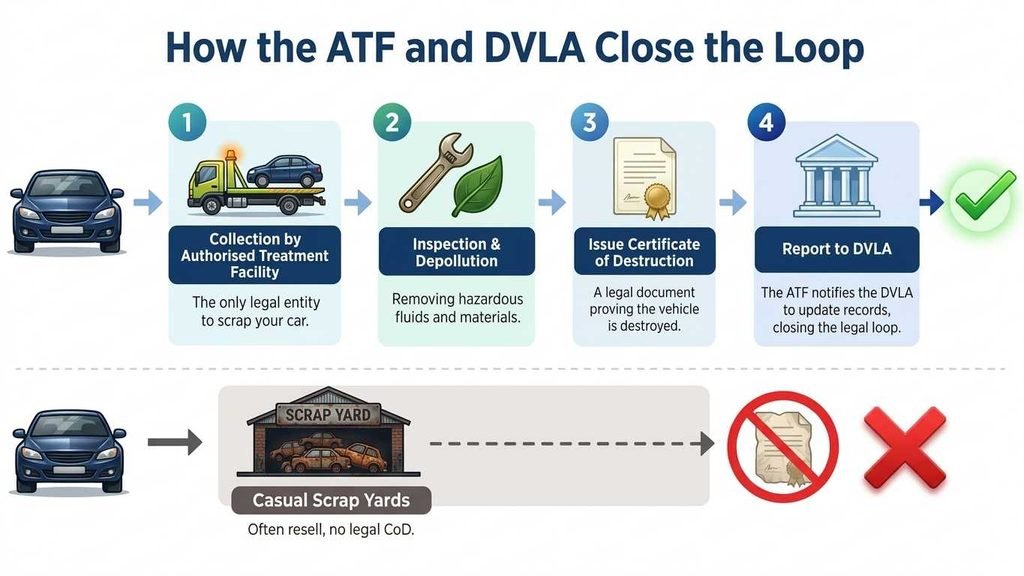
This is the stage of the process where things become relevant after the tow truck goes away.
In the case when a qualifying vehicle has been fully scrapped at an ATF, the facility provides a Certificate of Destruction (CoD). According to GOV.UK, for cars, light vans and some three-wheel vehicles, the CoD should be provided within 7 days after the complete scrapping of the vehicle.
The reason why it is significant is that it becomes the official proof of the destruction of the vehicle. An ATF uses DVLA’s Certificate of Destruction and Notification of Destruction service to notify DVLA and close the vehicle record after it has been properly processed by the facility.
Consider it the final document in the process. Your starting point was the unwanted vehicle parked outside your house. Next, you arranged the collection. The car gets to the ATF. It has been depolluted and processed. Then comes the official notification to DVLA. And finally, there is the Certificate of Destruction which means that the life of the vehicle is over.
That is the reason why one needs to choose the right way. You are not just handing money for having your unwanted car taken away. You are ensuring that your car goes through the proper disposal system.
Also from GOV.UK website, one can be fined up to £1,000 if one does not notify DVLA about the vehicle that has been taken to an ATF.
Pre-Scrap Checklist and Common Mistakes
Prior to your Manchester scrap car collection, here is a quick checklist to go through.
Locate your V5C: Be ready with your log book and ensure the vehicle information is accurate.
Verify your identification: Bring photo ID, if your collector asks for it.
Verify your address: In case the keeper information is outdated, find out what needs to be updated before collection.
Collect the keys: Add any spare keys that you may have, and inform about any lost keys in advance.
Verify the finance: Ensure that there is no open finance problem.
Clear out your stuff: Look through the boot, glovebox, centre console and the area under the seats.
Handle a private registration: Should you wish to keep the registration number, make it happen before scrapping.
Find out where the vehicle goes: Ensure that it will not go to an unauthorized place.
Keep your last papers: File away your Certificate of Destruction when it comes out.
The most convenient scrap car collection happens when all those boring details are taken care of before the driver comes.
It is no place to be standing on the doorstep of your house in Manchester at 8 in the morning trying to find your V5C because the recovery truck is already outside. A little preparation saves a lot of back and forth effort.
Final Thoughts
Disposing of a car will typically not involve difficult paperwork; however, the correct paperwork must be in place.
Ensure that you have your V5C, identify whether there are any additional documents needed for the process, let the collector know if any keys or issues are missing, and ensure that the vehicle is taken to an Authorised Treatment Facility. Perhaps the most crucial step of all is to not view the Certificate of Destruction as something that you just do at the end.
This can be done for many different reasons, including a long time parked up, an expired MOT test, too costly repairs or just the end of its useful life. If you would like further information regarding a quick scrap car removal in Manchester, visit Scrap Car Guys.
One Response