
When making the decision to scrap your old car, you could believe that the entire process stops once the recovery truck removes it from your property. The fact of the matter is that the removal of your vehicle is actually just the start, and there are other processes involved, such as assessing the condition of the vehicle, removing hazardous items, salvaging the useful parts and recycling the metals.
Knowing what comes next will put your mind at ease if this is your first experience in scrapping your car. If your car has failed its MOT test, has engine issues, or simply costs too much money to fix, then it will be good to know what happens during this process.
For those who plan to scrap their vehicle, you can learn about how to scrap your car in Manchester.
Your Car Is Taken to an Authorised Treatment Facility
First and foremost, there is a need to take the car to a proper place. In the UK, the vehicle that is being disposed of as waste needs to be managed by the authorized treatment facility. Such facilities are properly equipped to handle the disposal process as well as the management of the car’s different materials.
Once collected, the car is taken to the facility, where its condition and information about it are assessed. The team decides what will happen next depending on whether or not the car is reusable.
This is important since all vehicles that are no longer needed are not necessarily treated in the same way. For example, a car with a working engine, transmission, and/or without damaged body panels may be able to yield recoverable parts. Other vehicles suffering from corrosion, severe accidents, or mechanical failures cannot yield any recoverable parts besides materials.
If you are researching how to scrap a car, choosing an authorised facility is an important part of doing it correctly. You can find further information through the official GOV.UK guide to scrapping your vehicle.
The Vehicle Is Checked for Reusable Parts
The condition of the automobile and some of its parts can be assessed before its total dismantling.
For instance, a car which does not start can have functional headlights, doors, seats, mirrors, alternator, or a gearbox. Provided that these parts are in a suitable condition, they can be reused as spare parts for other cars.
This is one of the factors why the value of a car cannot be estimated solely by its weight. It can depend on the type of the car, its age, the demand for the part, and metal prices.
There are also some parts which cannot be reused due to their condition or unsuitability for reuse.
This is also true for salvage cars. Based on the history of the vehicle, its condition, and its status legally, some can be repaired or dismantled, whereas others should be considered end-of-life vehicles. This will be determined by the facility after evaluation of the vehicle.
When it comes to car owners, the significant thing is that a car can still be useful despite not being cost effective anymore in terms of driving it.
Hazardous Fluids and Materials Are Removed
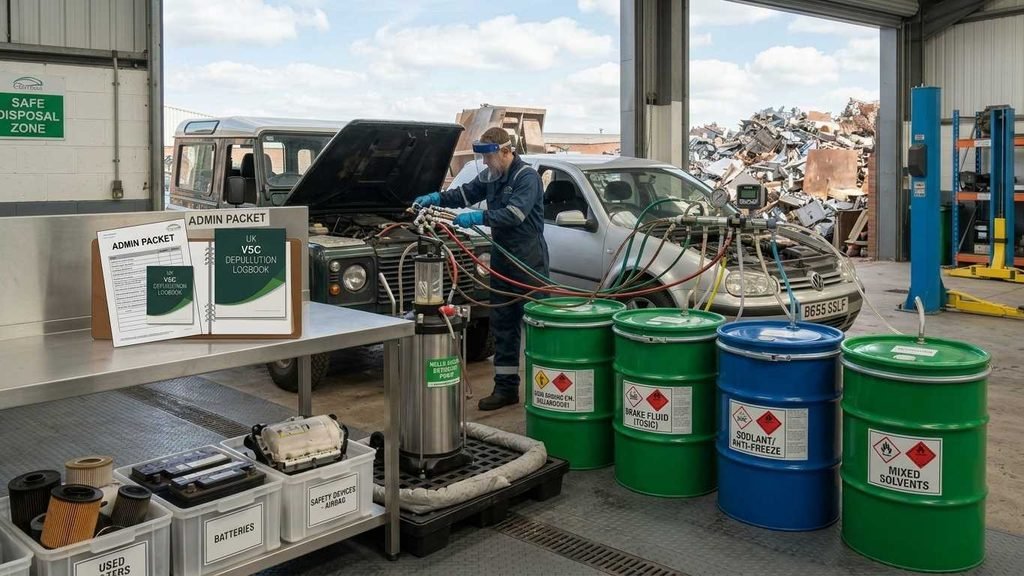
The depollution process is one of the most crucial stages in the vehicle recycling procedure. Prior to further dismantling and processing of the end-of-life vehicle, all hazardous materials need to be disposed of appropriately.
The list of fluids and elements contained in a car which cannot just go into the ground or regular garbage includes:
- Petrol or diesel in the car’s fuel system.
- Engine oil and transmission oil.
- Fluid for the brakes and coolant.
- Refrigerant for the air-conditioning system.
- Battery and other hazardous parts.
- Safety devices like airbags and other equipment.
It will entirely depend on the type of the vehicle and equipment used. The electric cars need special attention due to the high voltage systems which may pose extra hazards.
Why is this important? Consider an old car left standing in the driveway for several months without being driven anywhere. It will still have fuel, oil and coolant in it. They may pollute the environment in case of leakage during disassembly.
At an authorized facility, all these procedures will be followed to collect and store these substances in a proper way, allowing them to use the substances for proper treatment or disposal.
The Environment Agency’s guidance on end-of-life vehicle treatment explains the requirements facilities must follow when handling and depolluting vehicles.
Useful Components Are Removed for Reuse and Recycling
After the required decontamination procedures are completed, the car can then be broken down even further. Those components which are still good will be sorted out for possible use, while those which cannot be used again will be recycled.
These can include:
- Suitable engines and transmissions.
- Alternators, starters and other electrical equipment.
- Tyres and wheels, provided that they are in good condition.
- Doors, mirrors, seats and body panels.
- Catalytic converters and other components which have recoverable material.
- Glass and some plastic components.
For instance, there might be a case of an automobile whose MOT fails due to significant mechanical faults. It would not necessarily mean that all the parts of the car cannot be reused since the cost of repair might be too high.
There could be a part that can help repair another vehicle thus avoiding production of new parts for the car. Those parts which cannot be re-used will still have materials which could be recycled.
The point here is that simply because a part is not damaged it does not mean that it should be reused automatically. There is a need to evaluate whether a particular part can be reused, especially in cases like brakes, steering wheel, airbags and other safety mechanisms.
The Remaining Car Shell Is Processed for Metal Recycling
When the reusable parts and other materials are stripped away, what remains is a vehicle body that is ready for processing.
It is common to come across the word car shells in discussions about scrap yards and automobile recycling. This usually describes the remaining body structure of the car after a lot of other components of the vehicle have been stripped off.
The typical automobile has lots of steel in its body structure, although there are other vehicles that also have aluminum and other metals in their body structures. The vehicle must first be appropriately prepared before being sent to process the metal.
The body of the automobile can now be subjected to compressing or shredding at an appropriate recycling plant.
The recovered metals will be available to be used in the production of new items. The recycling of steel and aluminum might result in the reduced demand for raw materials, provided other aspects of processing and manufacturing processes are taken into account.
That is why the old automobile cannot be regarded as something useless even if it is not able to run anymore. Even if the engine is broken or the body is damaged, there is still a lot of material that can find its purpose.
The main thing is that the automobile should go through the right procedure and not be disposed of somewhere.
What Happens to the Car’s Value After Scrapping?
Most drivers seek to know if the parts of their vehicle will be reused, if the metal will be recycled, and how all these affect the money they will get.
That is a result of a variety of factors. Some vehicles will have reusable parts, and some vehicles might be valuable mostly due to the metal that can be taken out of them.
Some things to take into account when getting a quote on your scrap include:
- Make and model of the vehicle: Certain vehicles will have parts that are easier to sell and more in demand.
- Weight and metal: The amount of metal in the vehicle can play a role in its value.
- Condition: Functional parts will be an additional value, while significant damage can decrease reuse options.
- Completeness: Parts that are missing can also affect what is left to recycle.
- Market conditions: Scrap metal prices and demand for replacement parts change over time.
For instance, a car that is not running but has an operable transmission and unscratched body panels might be valued differently than another such car that is missing key parts. Both results cannot be determined without knowledge of the condition of the vehicle.
If you want to understand the factors that influence a local valuation, read our related guide: How Much Is a Car Worth for Scrap in Manchester?.
Comparing the offered deal with all terms that go along with it is much more sensible than opting for a service just because of its price tag. See if collection is included, how the payment will be made, and if the total price depends on your car details.
How the DVLA Is Notified When Your Car Is Scrapped
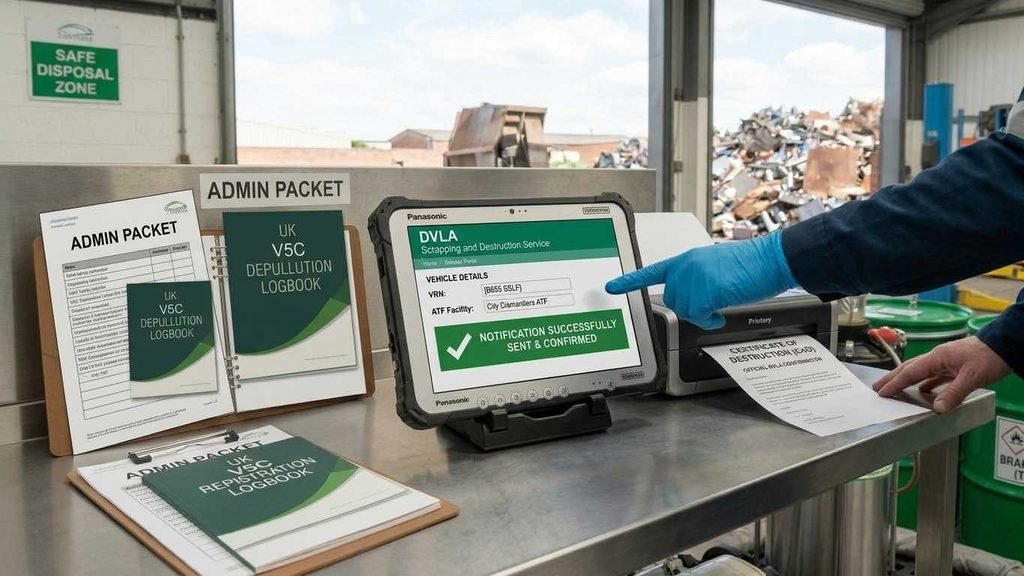
The recycling of the actual vehicle is just one step of the process. You also have to ensure that the legal aspects of the matter are taken care of in the correct manner.
The DVLA keeps vehicle registration records. If you want to scrap your car, you will have to give the notification accordingly.
If you are wondering about scrapping car DVLA requirements, start by checking the official GOV.UK instructions for scrapping a vehicle.
In the case of scrapping a normal car, the procedure entails a certified treatment center as well as a Certificate of Destruction. The Certificate of Destruction is an indication that the vehicle has been surrendered for destruction. The ATF is supposed to issue such a certificate within seven days after scrapping a car.
It will be helpful to comprehend the distinction between surrendering your vehicle and confirming that all the relevant procedures have been sorted out. One cannot conclude that everything administrative-wise has been done just because a recovery vehicle picked up the vehicle.
What Do You Need to Scrap Your Car?
Before arranging collection, it helps to understand what information and paperwork may be required.
If you are asking what do I need to scrap my car or what do you need to scrap a car, the V5C logbook is an important document to locate if you have it. It contains the vehicle’s registration details and information about its registered keeper.
According to GOV.UK, it is recommended that the V5C is passed on to the ATF while retaining the yellow portion that is meant for disposal, transfer or exchange of the vehicle to the motor trade.
In the event that you do not have the V5C available, do not be under the misconception that you will never be able to scrap the vehicle. Consult with the ATF.
The process on how to scrap a car is quite simple:
- Select a suitable authorized treatment facility.
- Give precise details regarding the condition of the vehicle and its whereabouts.
- Clarify the value, collection procedures, and mode of payment.
- Have the relevant vehicle documents ready.
- Acquire the necessary confirmation or certificate wherever required.
- Ensure that the DVLA notification requirements have been fulfilled.
This will make it easy for you to know what to do before handing over the car.
Why Responsible Car Recycling Matters
A vehicle is not just made up of metal alone. There are also elements like glass, plastic, rubber, electronic items, fluids, and safety equipment that are needed to take care of.
Recycling done in the right manner will ensure that the materials that can still be utilized are recovered and there is less vehicle waste that goes to where it does not belong. Proper depollution will also ensure that there is no contamination from things like fuel, oils, etc. in the environment.
It makes sense for motorists to ensure that the facility they choose is the one doing the right thing with their vehicles. This will help them understand the whole process better and have the right paperwork too.
Even if your car is worn-out, damaged beyond repair, or has not passed the MOT, it does not mean that its last journey cannot be used for material recovery.
Conclusion
When a car is taken to a scrapyard, it does not automatically end up there. It is evaluated, depolluted, disassembled, and recycled in order to recover useful parts and materials from it. The rest of the vehicle will go through a procedure to prepare it for metal recycling, while the necessary documentation will serve to properly document its disposal.
Before organizing the pick-up of the vehicle, make sure you choose the right place, know what you have agreed on and how much you have paid for it, and what documentation you are going to get in return.
In case you are interested in learning about scrapping your vehicle, visit Scrap Car Guys.
The list of location services that we currently provide includes: Oldham, Bury, Heywood, Middleton, Bolton, Stockport, Rochdale, Warrington, Cheshire, Mossley, Droylsden, Hyde, Denton, Ashton-under-Lyne, Dukinfield.
FAQs
Must I notify the DVLA about my car being scrapped?
It is important that you ensure that the DVLA is informed about scrapping of your car at the ATF facility. Follow the correct process since just having your car collected does not meet all requirements.
Can I declare car as scrapped online?
GOV.UK offers an online service for letting DVLA know that your vehicle is either scrapped or written off, based on your situation. Please refer to the government guidelines on vehicle scrapping and follow the relevant procedure.
Online search terms like declare vehicle scrapped, scrap my vehicle DVLA, DVLA scrap a car online and
What does DVLA vehicle scrapped mean?
It usually refers to a car that has been disposed of via the necessary procedures. In order to determine whether your own vehicle falls under this category, refer to your documentation as well as the guidance issued by the DVLA.
What if I have searched scraped my car DVLA but cannot find confirmation?
Make sure you have got all the required documents or not, and if something is missing, then get in touch with the garage accepting your vehicle. In case you still have doubts, approach DVLA via GOV.UK.
Does every scrapped vehicle receive a Certificate of Destruction?
When a qualified vehicle that can either be a car or a light van is destroyed at an ATF, then a Certificate of Destruction is issued. However, when the facility opts to refurbish the vehicle and sell it, then no certificate is issued.