
When deciding whether to sell or scrap a dilapidated vehicle, the answer may not be clear. Although selling the vehicle privately may give one a considerable amount of money, it would be much more practical and convenient to scrap the vehicle if it requires costly repairs or has been left without being used on one’s driveway for several months. In case one is thinking about scrapping their car in Manchester, it is important to compare both alternatives.
It should not be forgotten that the right choice is not only determined by age of the car. Mechanical condition, the cost of repairs, the current market value of the car, its demand and the effort that one is willing to put into selling it are also to be considered. For example, a ten year old car with a complete service record can be bought by second-hand car dealers, but it is quite difficult to sell a relatively new car that has engine problems.
It is necessary not to make any assumptions concerning the better way to deal with one’s vehicle. There are advantages and disadvantages to both alternative and one should know them. Below are the points to consider when choosing.
What Is the Difference Between Selling and Scrapping a Car?
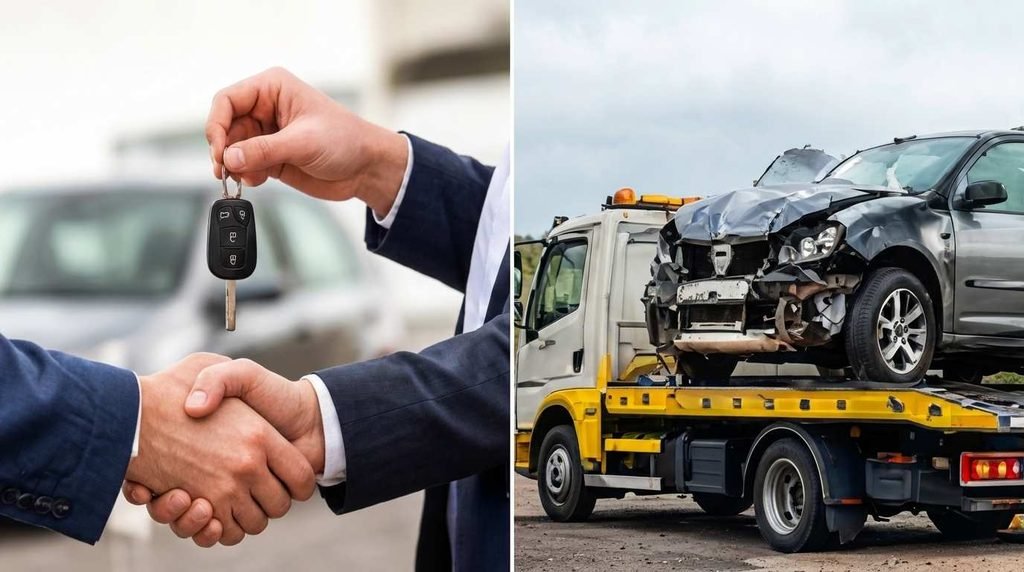
The sale of a car refers to the transfer of a car to another individual or company that will either use it, repair it or sell it again. Based on how the vehicle is, you can opt to sell the car privately, trade it in or take it to the motor trader.
The scrapping of a car involves transferring the vehicle to an end-of-life vehicle handler. The authorised treatment facility will ensure that the dangerous parts are taken away, reusable parts salvaged while the rest recycled. Sometimes based on the condition of the car and the decisions made by the ATF, the car may end up being repaired and sold again.
The key distinction between the two actions lies in the intent behind them. While the sale allows one to gain some value out of their usable car, scrapping is the better option when repairs, damages or condition of the vehicle are a hindrance to a normal resale.
For instance, suppose your vehicle has a fault with its gearbox. If your car is still in good shape and the problem is not very expensive to sort out, it would be sensible to sell it to someone who will have it fixed. However, if there are other costly faults besides the gearbox, you would want to see which is more economical between getting your car scrapped and fixing it.
The right choice cannot be assumed either way. It depends on what is most sensible to do with your own car.
The Pros of Selling Your Car
Selling is always the better choice when your car has years left in it and there are people who will pay for it.
1. You May Receive More Money
A car that functions efficiently, possesses a valid MOT, and has been appropriately maintained can have more value as a second-hand vehicle than as scrap material and spare parts.
Imagine a car used by a family for everyday purposes, which comes with a good service record, acceptable mileage, and has no mechanical problems. The person interested in purchasing a cheap second-hand car would appreciate its performance qualities. This customer buys a car as an assembled product, and not only for the material it consists of.
This is the reason for comparing prices of similar used cars prior to agreeing to the scrap estimate. Compare used cars of the same make, model, age, mileage, condition and service record.
It should be remembered that advertising prices do not necessarily represent the selling price of a particular car. For example, the vehicle put on the market at £2,000 may not actually cost this amount.
2. You Can Reach Different Types of Buyers
You do not need to use one single selling technique. Depending on the condition of your vehicle, you can go to a dealership, sell it privately or contact a motor trader.
The dealer may present advantages, especially in case you exchange your car when purchasing another one. The private buyer can be ready to offer a better price for a desirable brand or a car in a good condition. The specialist buyer can also be interested in a certain make or model. The presence of several buyers provides an opportunity to compare the offers.
Nevertheless, the most suitable way will depend on your situation. A car that requires major repairs may attract fewer buyers, even if it is a desirable brand or model.
3. The Car May Still Have Years of Useful Life
Agedness in itself cannot be the cause of getting rid of your vehicle. An old but well-maintained and functioning car in good condition will still have the potential of being able to provide transportation. And if its maintenance continues to be relatively inexpensive, then it makes more sense to sell it to a new owner rather than taking it for final disposal.
It also goes for some damaged cars where the owner may find a way to fix something that is too expensive for other people. Before making a decision, take into account the condition of the engine, transmission system, brakes, suspension, tires, and body of your car.
4. You Can Compare Offers Before Committing
When you sell, you get the chance to do market testing. You can do market research on comparable products, ask for valuations and consider the potential profits you could earn through various channels. This is especially helpful if you are not certain whether the repair would add enough value to cover for its cost.
For example, if you need £600 worth of repair to get the car ready for sale and you expect to sell it for £2,000, then you would have a £1,400 profit before taking into account the costs of advertising and preparing the car for the market. It does not necessarily mean that this is the right thing to do, but at least gives you a realistic basis for the consideration.
The Cons of Selling Your Car
While the process of selling may provide a good profit, it also entails some duties and challenges.
1. Finding a Buyer Can Take Time
The possibility that your car is a highly valued one in good condition will lead to it being sold within a very short period of time. If not, there may be a considerable amount of time to sell the used car that is in bad shape or having any defects.
You will have to take photos of the car, create the right ad, reply to questions and negotiate with possible buyers. There may be cases when some people will change their minds about the deal upon seeing the car and others will offer prices that will disappoint you. When your car occupies unnecessary space or you urgently need to buy another one, this factor can be taken into account.
2. Repairs and Preparation Can Reduce Your Return
Before selling the car, there is the option of making necessary repairs, changing tyres, cleaning the interior and making any other required repairs. These things can make the car more attractive, however, spending money does not necessarily mean that you will manage to recoup all of them in increased price of sale.
Let us take an example of an older car with a warning light on the dashboard, worn out tyres and MOT that is going to expire soon. You will spend money to solve these problems, however, other faults may appear as a result of the repair.
Before spending any money on the repairs, it would be wise to get a realistic estimation of the expected price of sale and compare it with the costs that you are going to incur for the preparation of the car. Honest description of the problems that the car has is essential.
3. Private Sales Require Careful Arrangements
Getting to know new people, making arrangements for test drives and paying may not be convenient. There is also the issue of securing your private data and making sure that the car is delivered correctly.
As per the DVLA, there is a requirement on the seller’s part to inform DVLA of the sale and supply the appropriate buyer details. This is provided officially by the DVLA on GOV.UK: Selling a Vehicle. Document your deal and do not rely on the buyer to register the change for you. If it is not registered on time, you may face avoidable issues.
4. A Higher Offer Does Not Always Mean a Better Deal
One purchaser may give you more than another but insist that you organize transportation or accept other terms. Compare the net sum after deducting any reasonable cost against the face value.
A working vehicle may make it easy to arrange the collection. If it has failed its MOT test or will not start, the process of moving it to the buyer may add some cost and hassle. The real worth of an offer lies in the money in your pocket and the effort involved to sell.
The Pros of Scrapping Your Car
It would be good to consider scrapping the car in instances where the state of the car makes it unfeasible for use.
1. It Can Be a Practical Option for Heavily Damaged Cars
Damage to engines, gearbox damage, corrosion, or extensive accident damage may increase repair costs beyond reason. Consider the case of an older car which requires a new engine and at the same time has issues with suspension. If it is repairable, then the cost of repairs will come close to its resale value.
In such situations, obtaining a scrap quote and comparing it to repair costs will help prevent unnecessary expenditure on a car that is unlikely to offer a good payoff. Scrapping valuation is not a valuation of a used car. The scrap value will take into account the car’s weight, recoverable parts, condition, and current market conditions.
It would therefore be advisable to check the real offers in regard to your car instead of taking the age and state of the car as fixed criteria for determining its scrap value.
2. You Can Avoid the Work of a Private Sale
Private sales typically involve advertisements, inquiries, viewings, and negotiating. In such a case, the scrap collection service may provide an alternative approach, especially when the car in question is beyond repair. The arrangement of collection depends on the service provider and your location. Collection can either take place at your place or another predetermined location.
This will be very handy when the car has been standing idle for several months, and you do not feel like wasting time trying to fix it, arrange for transportation or handle potential buyers who will have doubts about purchasing the car. It will be prudent to get the information regarding collection, whether there will be any fees involved, and mode of payments.
3. Non-Running Vehicles May Still Have Value
It is not always necessary for a car to start or move to become eligible for scrapping. Cars that have failed engines, failed MOT tests, are accident damaged or lack vital parts can still have materials or salvageable parts inside them. The value will be determined by the specific vehicle and the evaluation of the potential buyer.
If your car has been left idle in your garage due to the fact that the engine won’t crank, a traditional buyer may not want to buy it unless he carries out an inspection first or may want to sell it at a discounted price due to the risks involved. The scrap price quotation gives you another alternative to compare. It is important to provide accurate information about the vehicle when asking for it.
4. Responsible Recycling Reduces Waste
Disposing of the vehicle at a registered treatment centre will enable recycling of the components of the vehicle, instead of allowing the unwanted vehicle to decay. The vehicle contains materials that need to be managed well. The ATF can depollute the vehicle and reclaim the useful parts. Apart from being environmentally sound, it is essential to choose the right place to make sure that the process is legal.
5. You Can Compare the Value of a Damaged Vehicle Without Repairing It First
Another benefit of getting a scrap valuation is the opportunity to look at an alternative solution without having to incur the cost of repairs right away.
For instance, when there are various issues identified by the mechanic, you get the cost of repairing the vehicle and then request a scrap valuation. The figures obtained will aid in making an informed decision on whether the extra cost is worth it. It is important to note that not all damaged cars need to be scrapped. A relatively new car with some repairable issue might still have good resale value.
The Cons of Scrapping Your Car
It can be quite easy for scrapping, but there are cases where scrapping may not prove to be economically feasible.
1. You May Receive Less Than You Could by Selling
The car may have some worth for others as used vehicles because it is roadworthy and in high demand on the used car market. It is possible that such a car can be attractive for someone who is looking for a reliable means of transportation. Scrapping the car without valuing its potential resale value may result in losing money.
This is one of the reasons why you should do your research on both ways. Ask for a reasonable used car value and compare it with scrap prices. Include all expenses that will be required when selling the car.
2. You Lose the Opportunity to Sell It as a Usable Vehicle
After the arrangement for the scrapping of your vehicle, when the vehicle goes through the end-of-life treatment process, you will not be able to reclaim your vehicle as a regular used one. In case the vehicle is repairable and the decision-making process regarding your decision is not completed yet, you need to give some thought to the resale value of your vehicle.
This is especially true for rare, classic or well-equipped vehicles whose value differs from the value of scrap depending on the interest that an enthusiast can have for them. If you think your vehicle has special value, you should consider having it valued before disposal.
3. You Need to Check the Collection Terms
Every scrap collection quotation does not operate the same way. It all depends on the location of the car, accessibility to the car, lack of some parts and if the car is safe to transport. There are cars which need special recovery machinery especially those that cannot roll or steer.
When comparing your quotations, inform the firm the condition of the car and ask them if the price quoted covers the cost of collecting. Inform them if the amount is subject to change due to the condition of the car.
4. The Legal Paperwork Still Matters
Disposing of a car does not imply that the relevant documents are ignored. For cars in the UK, they should be processed by an authorized treatment facility. Once a vehicle is scrapped fully, the ATF issues a Certificate of Destruction (CoD). This shows the destruction of the vehicle. The certificate is usually issued within seven days from the time that a vehicle accepted for total destruction.
DVLA gives information about how the certificate is issued as shown below: Where vehicles can be scrapped. It is important to have clear knowledge on who will handle the notification and what kind of confirmation you are going to get. It is not always true that every vehicle that goes to a motor trader receives a CoD, depending on whether it is scrapped or repaired and then sold out.
5. You Need to Check How Payment Will Be Made
The mode of payment is another point which should be clarified before anything else. Cash payment is not allowed for vehicle scrapping in England and Wales; the payment should be done through a bank transfer or cheque. This information can be found in the GOV.UK Vehicle Scrapping Guide.
The amount, the way and time of payment should be confirmed before accepting collection of a vehicle. In any case, an agreement is better than a verbal promise of good money.
What Should You Consider Before Choosing?
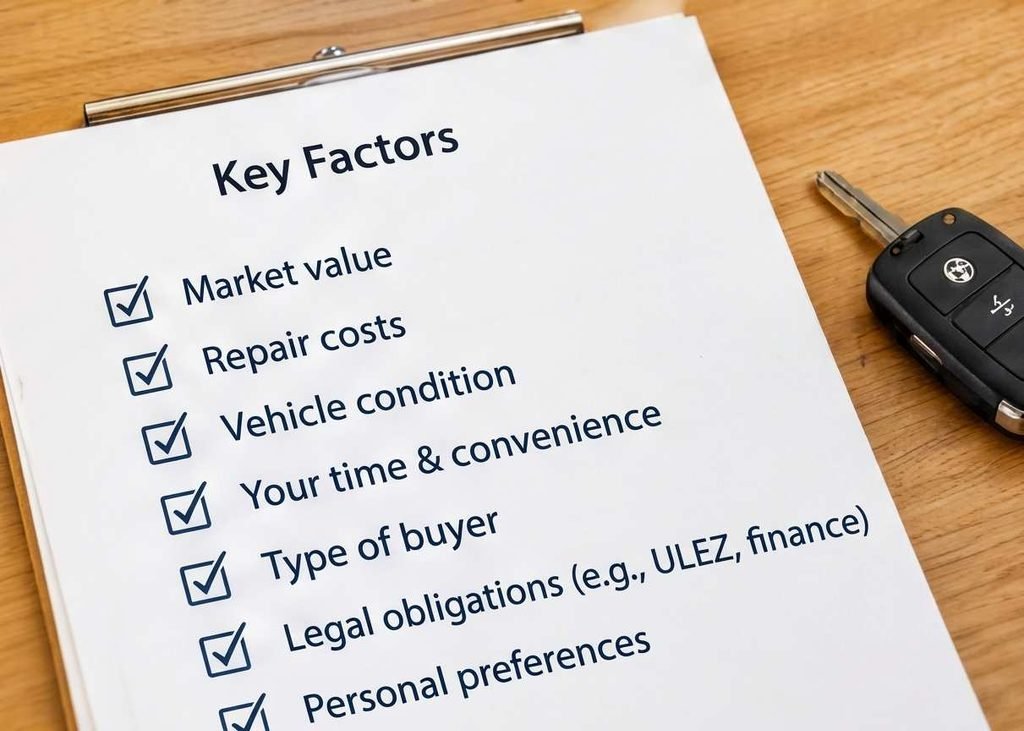
The choice will become much simpler once one compares all the elements involved in each alternative rather than considering only a single statistic.
1. The Car’s Current Market Value
Compare the prices of similar cars on the market before making a decision. Consider the make, model, age, mileage, specifications, and condition of your car.
Your car might still have a good resale value despite being an older vehicle. But it should be noted that the price stated in the ad is not binding. In case you are having a hard time finding vehicles similar to yours because it is severely damaged, then consider scrap values too.
2. The Cost of Repairs
Ask a garage for an estimate if the car has mechanical issues. Think about not only the problem at hand but also about the likelihood of additional work being needed.
It is worthwhile to fix the car if there is still a lot of value left in it. However, fixing a vehicle with several costly parts going wrong which is not worth very much might not be as beneficial. Calculate how much money you would make selling the fixed car versus selling it as-is.
3. The Vehicle’s Condition
The condition impacts the number of prospective buyers as well as the offers that will be presented to you. A clean and fully functional car with an up-to-date MOT and maintenance records could prove popular among private buyers. The condition of a severely corroded car with accident history and significant mechanical problems is likely to make its sale problematic.
If the car does not meet the criteria of being road-worthy, you cannot assume that it is legally and safely capable of being driven to a buyer.
4. Your Time and Convenience
Consider the urgency with which you want to sell the car and the amount of energy you would like to expend on the process. Selling it privately would take multiple viewings and bargaining. Scappling the car might be an easier way out, especially when the vehicle is no longer operational; but it is best to compare quotes and terms anyway. The best course of action isn’t always the one that brings in the highest theoretical cost, but rather the one that gives you a decent profit minus expenses.
5. The Type of Buyer Interested in Your Vehicle
Various customers have different needs when buying cars. An individual customer might require an automobile that will serve him for his day-to-day activities. The dealer might view the car from the point of view of its resale value and the cost of preparations. The specialist might be interested in a particular vehicle. Realizing the identity of customers can assist in realizing whether one should pursue the quotations or not.
6. The Paperwork and Transfer Process
Whatever decision you make, ensure that you know the administrative procedure involved. If you are selling your vehicle, inform the DVLA and ensure that the proper keeper transfer process is followed. If you intend to scrap the car, ensure that it is done at an authorized treatment facility following the required procedures for notification.
If your car has a personalized registration number that you wish to keep, ensure that the number is detached from the vehicle using the services of the DVLA. The records will assist in determining what has been done to the car.
Selling vs Scrapping: Which Option Is Better?
The following comparison can help you narrow down your options.
| Factor | Selling your car | Scrapping your car |
| Potential financial return | May be higher for a desirable, usable vehicle | Depends on scrap value, parts and vehicle condition |
| Repair costs | Repairs may improve the sale price but reduce your net return | You can often request a valuation without repairing the vehicle |
| Time and effort | May involve adverts, viewings and negotiation | Can be more direct when collection is available |
| Non-running vehicles | Possible to sell, but the buyer pool may be smaller | Often worth considering |
| Vehicle condition | Good condition generally helps resale | Damaged vehicles may still have recoverable value |
| Environmental handling | Depends on what the buyer does with the vehicle | An ATF can process an end-of-life vehicle appropriately |
| Paperwork | Notify DVLA of the sale | Follow ATF and DVLA requirements for scrapping |
The answer will be different for different vehicles. The best way to go about it is by comparing the actual prices and the difficulties involved.
How to Make the Final Decision
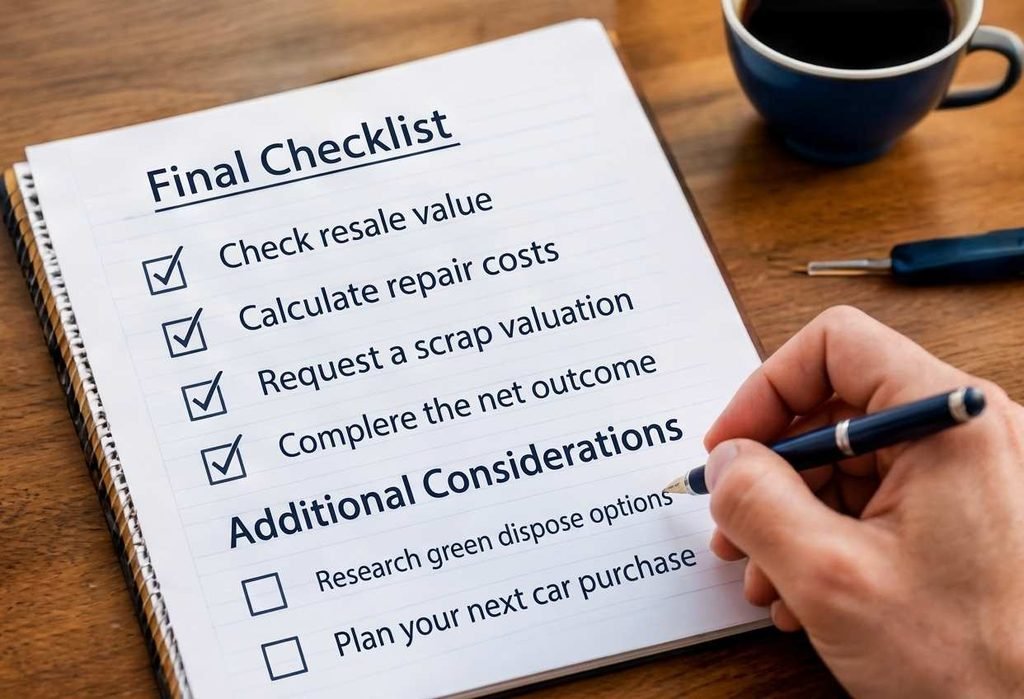
Before you decide to sell or scrap your vehicle, try spending some time in following the steps below.
- Determine its real market value: Use other vehicles as a basis instead of just using asking prices.
- Determine possible repair cost: Get an estimate if you plan to have repairs done before selling the car.
- Ask for a scrap price: Explain the vehicle properly by describing its condition (damages, missing parts, etc).
- Compare the results: Consider all costs like the repairs, transportation, preparation and time involved in the process.
- Review the details: Make sure you understand the price, collection procedure, payment options and any conditions.
- Do the paperwork: Make sure you follow all the requirements of the DVLA and keep proper documents about the transaction.
If scrapping turns out to be the best decision, use only authorized facility and know how the vehicle will be processed. If selling is more profitable, then do everything you need to sell the vehicle safely and inform the DVLA about it.
Conclusion
Sales become an alternative that is worth investigating when your car still has value, is reliable and affordable to maintain. This will give you an opportunity to get some money for the car’s value as a working vehicle.
Scrap becomes a relevant alternative when repairs or the state of your vehicle makes further use unattractive or resale of your car is not profitable enough. It can also be a relevant alternative when you prefer not to spend time arranging your vehicle’s resale.
None of the alternatives must be chosen without analysis of all aspects of the problem. Estimate the price at which you may sell your car, costs of repairs, prices for scrapping and the costs of collection of your vehicle and then choose what fits better.
When you have decided to scrap your car, one of the companies that could be considered while making the decision is Scrap Car Guys. Analyze the information about their service, ask all possible questions regarding scrapping of your vehicle and arrange the process according to your needs. For detailed information about services, see the homepage of Scrap Car Guys.
Service locations: Oldham, Bury, Heywood, Middleton, Bolton, Stockport, Rochdale, Warrington, Cheshire, Mossley, Droylsden, Hyde, Denton, Ashton-under-Lyne, Salford, Milnrow, Littleborough.